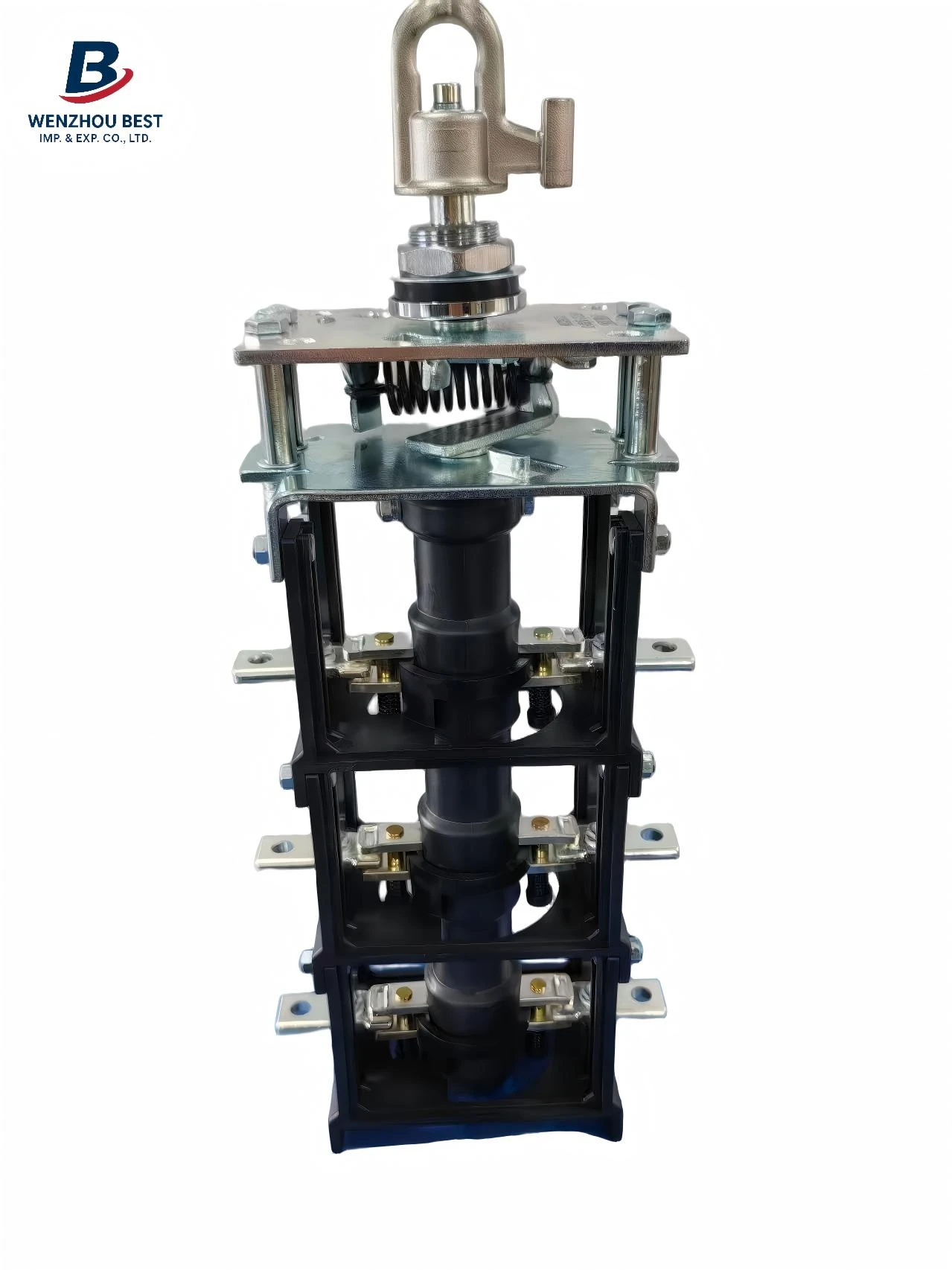
China Oil Loadbreak Switch Original Manufacturer-Wenzhou Best Imp. &Exp. Co., Ltd
Introduction
In medium-voltage power distribution systems, reliable switching equipment is essential for transformer operation and power supply management.
The four-position oil-immersed loadbreak switch is designed to provide flexible circuit selection and switching functions in oil-filled distribution transformers. One common configuration is the Selector Blade – 1 Blade Center, which allows the selection of two alternative incoming power sources connected to a common output circuit.
In this article, we explain its working principle, switching positions, internal structure and applications, with reference to the Eaton Cooper Power Series four-position sectionalizing loadbreak switch.

1. What Is a Four-Position Oil-Immersed Loadbreak Switch?
A four-position oil-immersed loadbreak switch is a medium-voltage switching device installed inside an oil-filled transformer tank.
It allows operators to establish or interrupt electrical connections under specified load conditions, providing circuit selection and sectionalizing functions.
Compared with a conventional ON/OFF switch, its multiple operating positions provide greater flexibility for transformer primary circuit configurations.
Typical applications include:
Pad-mounted distribution transformers
Loop-feed distribution transformers
Underground power distribution networks
Medium-voltage distribution equipment
2. Working Principle of Selector Blade – 1 Blade Center
The Selector Blade – 1 Blade Center configuration uses a centrally positioned rotating blade to establish different electrical connections between incoming terminals and a common output terminal.

It provides four mechanical operating positions:
| Position | Electrical Connection | Function |
|---|---|---|
| Position 1 | A – C | Line A connected |
| Position 2 | Open | Circuit disconnected |
| Position 3 | B – C | Line B connected |
| Position 4 | Open | Circuit disconnected |
Position 1 – Line A to C: The selector blade connects incoming Line A to the common output terminal C.
Position 2 – Open: The blade moves to an open position, disconnecting both incoming sources from the common output.
Position 3 – Line B to C: The blade connects incoming Line B to the common output terminal C.
Position 4 – Open: The switch moves to another open position, leaving both incoming sources disconnected from the common output.
This arrangement provides two alternative source-selection positions with separate open positions between them. The two incoming sources are not intentionally connected together through the selector blade.
Actual switching operations must follow the manufacturer's operating instructions and the system's protection and interlocking requirements.
3. Main Components and Design Features
The performance of an oil-immersed loadbreak switch depends on its contact assembly, operating mechanism and insulation system.
Moving Selector Blade: The main switching component rotates to establish the required electrical connection at each operating position.
Fixed Contacts: These provide stationary electrical connection points. Contact pressure, surface quality and conductivity are important for minimizing contact resistance and temperature rise.
Operating Shaft and Mechanism: The operating shaft transfers movement from the external operating handle to the internal switching assembly, ensuring controlled and repeatable operation.
Arc-Interruption System: During load interruption, an electrical arc may form between separating contacts. The arc-interruption design controls and extinguishes the arc within the insulating liquid under specified operating conditions.
Insulating Supports: These maintain electrical clearances and provide mechanical support for the contact assembly.
4. Eaton Four-Position Sectionalizing Loadbreak Switch: An Industry Reference
Eaton Cooper Power Series offers four-position sectionalizing loadbreak switches for medium-voltage distribution applications.
Its Selector Blade – 1 Blade Center configuration provides an industry reference for understanding this switching arrangement.
Eaton's catalog CA800005EN also illustrates other blade configurations, including Straight Blade, Selector Blade – 1 Blade Side, V-Blade and T-Blade.
Each configuration provides different electrical switching functions depending on its contact arrangement and circuit design.
An important distinction is that Selector Blade, V-Blade and T-Blade configurations are not interchangeable. Their electrical connection sequences and switching capabilities must be evaluated according to the manufacturer's wiring diagrams.
When selecting a loadbreak switch, engineers should consider the actual switching function rather than simply comparing the number of operating positions.
5. Break-Before-Make and Make-Before-Break
Two important switching concepts are Break-Before-Make (BBM) and Make-Before-Break (MBB).
Break-Before-Make (BBM): The existing electrical connection is interrupted before another connection is established. This prevents intentional bridging of two independent incoming sources during the switching sequence.
Make-Before-Break (MBB): The new connection is established before the original connection is interrupted. This may help maintain power continuity during switching, but can temporarily connect two power sources together.
MBB requires suitable source synchronization, protection coordination and system design. It should never be assumed from the number of switch positions alone.
6. Applications in Distribution Transformers
Four-position oil-immersed loadbreak switches are suitable for transformer designs requiring alternative primary circuit connections.
Pad-Mounted Transformers: The switch can be installed inside the transformer tank to provide primary-side circuit selection.
Loop-Feed Transformers: In underground distribution networks, alternative supply paths provide flexibility for network reconfiguration and maintenance. A suitable sectionalizing switch can support the required switching arrangement.
Industrial and Commercial Transformers: The switch can be incorporated into transformer designs requiring alternative power supply configurations.
The final selection depends on the electrical system, transformer design and protection requirements.
7. Key Technical Considerations
When selecting a four-position oil-immersed loadbreak switch, engineers should evaluate:
Rated Voltage: Compatibility with the system voltage and insulation requirements.
Continuous Current: Ability to carry the expected operating current within specified temperature-rise limits.
Loadbreak Capacity: Ability to interrupt the specified load current safely.
Short-Circuit Withstand: Compatibility with system fault levels and protective devices.
Contact Materials: Electrical conductivity, contact resistance and thermal performance.
Mechanical Endurance: Reliability of the operating mechanism over its specified operating life.
Insulating Fluid Compatibility: Suitability for mineral oil or other approved insulating liquids.
Installation Configuration: Mounting arrangement, operating shaft and electrical clearances.
8. Wenzhou Best Imp. &Exp. Co., Ltd. – Oil-Immersed Loadbreak Switch Solutions
Wenzhou Best specializes in medium- and high-voltage transformer components and switching accessories for power distribution applications.
Our oil-immersed loadbreak switch solutions are designed for integration into oil-filled distribution transformers and related electrical equipment.
The Selector Blade – 1 Blade Center configuration provides four defined switching positions for selecting between two incoming circuits and a common output terminal.
We support transformer manufacturers and electrical equipment companies with customized solutions based on technical drawings, electrical specifications and application requirements.
Whether you are developing pad-mounted transformers, loop-feed distribution transformers or other oil-filled electrical equipment, Wenzhou Best welcomes OEM cooperation and technical inquiries.
Contact Wenzhou Best for product drawings, technical specifications and customized transformer switching solutions.
Frequently Asked Questions
Q1: What is a Selector Blade – 1 Blade Center loadbreak switch?
It is a four-position switching configuration using a centrally positioned selector blade. It provides two alternative source-selection positions, connecting Line A to terminal C or Line B to terminal C, with two separate open positions.
Q2: What is the difference between a selector blade and a V-blade loadbreak switch?
A selector blade selects between specified incoming electrical paths, typically connecting one source to a common output. A V-blade uses a different contact and blade arrangement and can provide additional circuit configurations depending on its design.